
Do you want to know how to optimize employee control and maintain effective records? We’ll explain how to do it thanks to different time control tools about employee timekeeping.
Royal Decree-Law 8/2019, known as the Employee Time Control Law, requires all companies to have systems to monitor compliance with employees’ schedules, i.e., to keep a daily record of the start and end times of their working day.
Currently, there are different tools for controlling employees’ time and attendance, all guided by the same objective: to carry out an adequate registration and control of employees’ entry and exit. But not all options available in the market adapt correctly to different work modalities and positions, or they hardly offer reliable and objective data.
telecommuting work flexibility
Mechanisms and systems for employee time control
Essentially, time control tools record the entry and exit times of a company’s personnel, generating reports of such records; some also include breaks and rest periods of workers. But why is it so important to consider using time control software or applications? Their goal is to analyze how many hours are worked, the punctuality of the worker, the incidents that may arise during the day, and the overtime worked.
When we have to evaluate software for employee time tracking or any of the different time control systems, we have to leave aside the traditional timekeeping in Excel; otherwise, it will not be possible to take into consideration all the possibilities that exist in the current market.
Among the most used methods for controlling employees’ schedules are the following:
Employee time control through versatile systems
A versatile clocking system is agile and flexible, adapting to different types of work development or types of workers: workers who carry out their workday at a client’s location, telecommuting situations, workers with flexible hours, or reduced hours, etc. Additionally, it can be used from various devices: mobile phones or computers.
Versatile systems allow manual timekeeping by employees themselves, but they also have the option of fully automatic and real-time registration, generating daily reports or within a specific period, and completely objective.
Time@Work is a software for attendance and hours tracking that allows for comprehensive control by managers and executives over the workday of their collaborators and teams, as required by the time control law.
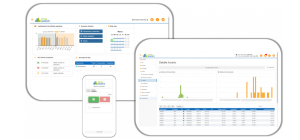
It is a versatile system; employees can register their workday through the application on their mobile phones or tablets, and they can even forget about manual clocking thanks to its 100% automatic timekeeping, once the employee logs in on their computer.
WorkMeter’s time management software records and documents the time dedicated to breaks, rest periods, or other interruptions, so that the daily effective working time can be defined. Additionally, it has a comprehensive vacation and absence manager.
It is a complete employee time tracking software. Without a doubt, it will facilitate and streamline the work of the Human Resources department and talent management. If you wish to try WorkMeter’s time management software, request a completely free trial.
Declarative online systems as a solution for employee time control
Declarative online systems are another option for monitoring employees’ time and attendance, as well as supervising their schedules.
This type of attendance control software provides access to employees through a web environment that allows them to record the start and end times of each of their workdays.
They are manual time control tools, which means they can be subject to error since their information is subjective, providing data on labor attendance control.
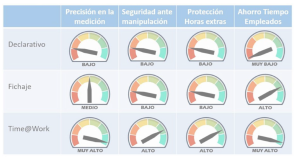
Physical clocking systems for employee entry and exit control
Physical clocking systems are employee time control devices incompatible with new work environments: hybrid work, telecommuting, flexible schedules, etc. These are physical devices placed at the entrances and exits of headquarters, areas, or offices.
Magnetic stripe cards
The operation of this time control system is simple: each employee has a card that must be passed through a device dedicated to reading and registering their entry and exit from the office. The card has a magnetic stripe, a barcode, or a QR code that allows the employee’s information to be recorded.
Proximity cards
Proximity cards are an alternative for controlling employee entry and exit, quite particular but widely used.
This type of card uses RFID technology (Radio Frequency IDentification). A proximity card is a plastic card that contains an integrated circuit and a communication antenna embedded in its core. Each card contains a serial number that is read by radio frequency, typically 125kHz.
Proximity cards are capable of transmitting when a unique code, with over 1 trillion possible combinations, is brought close to the appropriate reader. Their durability is superior to that of magnetic stripe cards since the reading occurs without physical contact, minimizing wear and tear.
Biometric systems for employee time control
Biometric systems for employee control are highly sophisticated and interesting systems because they eliminate the most common frauds. They result from the application of mathematical and statistical techniques on a person’s physical or behavioral traits to verify identities or identify individuals.
Examples of physical characteristics include fingerprints, facial patterns, retinas, iris, or palm geometry. Their main disadvantage is their high implementation cost due to the technology they use.
- Fingerprint identification: It works by recognizing the fingerprint of one of the fingers of the hand. The automated fingerprint identification system has a 99.9% security index.
- Vascular biometrics identification: It reads the vein patterns of the hands. The most reliable and secure technology within hand biometrics is one that consists of a scanner that captures an image of the vein pattern of the palm through the reflection of shortwave frequency waves (very similar to infrared).
- Facial biometrics identification: Facial biometrics recognition is a technology that requires very specific conditions, especially light, so its performance may be affected by circumstances unrelated to individuals.
- Iris or eye scanner identification: This system is technologically very secure but is also quite expensive. It is usually used to protect facilities that require a high level of security.
- Hand profile biometrics: It works by recognizing the morphology of the hand.
- Signature sheets: It involves manually registering entries and exits, reporting them on spreadsheets. Microsoft Office itself has various templates.
Activity control systems, beyond time control
We have explained the different real and objective time control tools, but how do you monitor effective work activity of employees? A need increasingly present, especially during telecommuting modalities.
To control work activity, companies have different methods and tracking systems. Mainly, what companies seek is to block access to certain websites, such as social networks, or program downloads, music, movies, etc. Among the most used methods are the following:
Blocking proxies
A proxy is a tool that acts as an intermediary between a computer and a web address. That is, through a proxy server, a computer in the company’s network will be directly connected to the Internet, filtering and distributing access to the rest of the organization’s equipment.
It works by establishing “Whitelist” systems, where a list of permitted web addresses is set, which will be the only ones that can be accessed; or “Blacklist,” where the list includes non-permitted web addresses, so only that group of pages would be restricted, while all others would be accessible.
In addition to URLs for social networks, messaging services or download programs can also be blocked. The advantage of this method is that it allows adjusting the block to a specific schedule, making it possible to schedule it to be released during the breaks of the staff.
Firewalls
They are systems that, by default, are included in the computer’s operating system. Its main advantage is the simplicity that allows blocking any type of program or website from the same computer, but this benefit comes with a drawback.
The disadvantage is that the computer user could modify the firewall’s configuration to bypass the restrictions established by the organization, depending on their computer knowledge and level of access, so it is advisable not to enable it as an administrator.
Geolocation through GPS
Some companies adopt geolocation systems to know, at all times, where employees are (inside and outside the company). This system is suitable for fleets and commercial vehicles, mobile sales positions, transporters, and general delivery personnel.
It is important to clarify that all the systems presented can be perceived as invasive and aggressive by workers, having a completely negative effect on their work and causing:
- A tense work environment.
- Work demotivation.
- Little involvement from human resources.
The consequences of such actions can even lead to the loss of talent, resulting in the company’s loss of competitiveness in the market. Something no company can afford in these times.
An integrated software solution: Employee time control and productivity activity
Many companies began to adapt the remote work or telecommuting model to ensure the safety, well-being, and peace of mind of their employees. Now, the challenge for companies, in addition to maintaining hourly control of their professionals, is to measure and understand their level of telecommuting productivity, as well as to prevent absenteeism and optimize talent management in general.
That’s why at WorkMeter, we took a step further with performance management software. Time control tools for employees: it details the start and end times of the workday, the actual activity, break times, and overtime worked. But it also measures productivity, evaluates performance, allows analysis of time investment in value-added activities without violating employees’ privacy, ensures digital disconnection, complies with legal regulations, and includes a comprehensive vacation and absence manager.
WorkMeter’s performance management software aims to help companies modernize their management and promote a data-driven culture, offering employees objective information about their performance, measuring their productivity levels so that they can optimize their work time management and increase their performance.
A solution that brings together the necessary functionalities for effective monitoring and objective timekeeping. All in one software. A perfect combination!